Friday, July 7, 2017

Quinoa Pasta with Farmer’s Cheese, Pistachios, and Kale

Today’s recipe is brought to you by the letter P: 
Pasta, Pistachios, and Pfarmer’s Cheese. 
And perhaps Picnic.


Cheese is a very personal thing. Think about it. Do you prefer soft or hard cheeses? What about the stinky ones? How about real vs. fake cheese? I could be wrong (duh) but it seems Big Food cheese manufacturers in the U.S. don’t even pretend their products are real. Does anyone know what “processed cheese food” is?

It could be sticky, artificially-colored orange goop wrapped in cellophane “singles,” or maybe Easy Cheese in a spray can or Cheese Whiz in a jar. And let’s not forget the enigmatic brick of golden mush called Velveeta—a name I like to imagine was once bestowed on a beauty shop proprietress in a remote West Texas town.

photo: retroland.com 


Michel is finicky about cheese. He’s also quite knowledgeable about it. This attitude is to be expected, given that Holland is one of the top cheese exporters worldwide. The kaaswinkel is an important part of Dutch neighborhoods and the daily food shopping routine that also includes stops at the butcher, the green grocer, etc.


Cheese is such an integral part of the Netherlands’ history and culture that there is an actual cheese museum in the city of Alkmaar. The Hollands Kaas Museum website is very engaging and filled with nerdy trivia for compulsive consumers of generally useless information—like this writer (and some of you, too—you know who you are).


How else could a person learn that a guild of Cheese Carriers was established in 1593? The leader of the Cheese Carriers was call the Kaasvader, a/k/a cheese father. [Insert your Star Wars parody ideas here.] To show that he was no ordinary schlepper, the Kaasvader donned a special orange hat, carried a black cane with silver embellishments, and sported a coat of arms on his chest.


Gouda Cheese Market photo: cdn.thecrazytourist.com

Gouda is probably the Dutch cheese that first comes to mind for most of us. It’s produced in the city of Gouda, which is a tricky name to pronounce for non-native speakers. In the U.S. most people incorrectly call it “Goo-dah” and some take things even further by making bad puns about it, e.g., “This is really goo-dah cheese.” Ugh.


For the record, the Dutch pronunciation of the name Gouda sounds like “How-dah.” The initial G should sound like you have something in your throat, perhaps a hairball: “hkhkhkhow-dah.” If you happen to be a fan of IPA, the International Phonetic Alphabet (yay for you!), here’s what it looks like:  /ˈɣɑu̯daː/

photo: ruralsociologywageningen.files.wordpress.com

Dutch farmer’s cheese is called Boerenkaas, also made in the city of Gouda from the same ingredients. Boerenkaas is made daily and it isn’t aged, ergo its fresh, cottage-cheesy consistency and its very important expiration date. Gouda is aged; the longer the aging process, the higher the price. In short (too late), all boerenkaas is gouda but not all gouda is boerenkaas. #Logic.


As tastes have evolved here in the states and our population has become increasingly diverse, it’s easier to find a variety of cheeses and other exotic ingredients that would have been impossible to get in the days of Hickory Farms cheese logs. 


Michel has witnessed a huge shift in Americans’ interest in food and cooking since he first arrived in New York at the age of 21 to study the violin and conducting. In fact, he was totally enamored with watching American television and eating TV dinners—just living the dream like the rest of us and expanding his English vocabulary via sitcoms and late-night talk shows. Now he enjoys perusing the specialty offerings at Whole Foods and Lotsa Pasta, various international food markets in town, and even the Murray’s cheese counter at Kroger.


Michel’s latest pasta dish is quick and easy to prepare and can be served warm or cold. He generally avoids cooking with carb-heavy wheat pasta, opting for noodles made from quinoa/corn flour for this recipe. The texture may seem a little odd at first but the nutritional trade-off is worth it. Either way, it’s a delicious take on mac-n-cheese and you’ll impress your new friends at the neighborhood summer potluck.


You will need:

3 tablespoons olive oil (+/-)
1 package of quinoa shells (or whatever pasta you prefer)
¼ cup pistachios, chopped
8 oz. carton of farmer’s cheese
1 bunch fresh kale
4 cloves garlic, chopped
3 tablespoons grated Parmigiano reggiano
1 tablespoon dried basil (“dried will do, fresh would be better”)
1 teaspoon sambal (or other pepper)


Remove stems from kale and tear the leaves into large pieces.

Steam the leaves for about 10 minutes (“until they wilt”).


Meanwhile:

Place chopped pistachios in a large mixing/serving bowl.

Put the water on to boil and follow cooking directions for your preferred pasta.


Heat “a little olive oil” in a medium skillet. Add chopped garlic, basil, and sambal.
Cook over medium heat for about 10 minutes (“until the garlic gives off its fragrance”).


Remove steamed kale leaves and chop into small pieces.


Back to the mixing bowl:

Add the chopped kale, garlic, basil, and sambal. 


Add one carton (8 oz. +/-) farmer’s cheese and 3 tablespoons grated Parmigiano reggiano. 


Drizzle 3 tablespoons olive oil over the ingredients. 


Stir until ingredients are well mixed. Add cooked pasta and stir again to integrate the noodles.


Serve and eat, warm or cold.

Easy.


Saturday, April 29, 2017

White Asparagus, Photosynthesis, Dutch Treats


Everything your elementary school teachers told you about photosynthesis is true. I’m no expert but I can understand that white asparagus exists for our consumption through the magic of science and the painstaking care required to cultivate this special plant.


Asparagus season is a big deal in Holland. The white asparagus harvest is so highly anticipated that the Dutch call it witte goud, or “white gold.”


White Asparagus beds at Santspuy farm in Etten Leur, Netherlands
Photo: crazydutchfoodie.blogspot.com


Traditionally, Dutch families who routinely dined at home would go out to a restaurant for a festive meal of white asparagus served with a special type of ham from the province of Gelderland. 

For trans-Atlantic travelers, these items also appeared in season on some vintage Holland-America Line menus. (Also, I'm happy to report that I have now discovered a whole new nerd playground in the New York Public Library online archives, fyi. Thanks, Google.)

Vintage Holland-America Line Menus (1899,1953)
New York Public Library Photo: menus.nypl.org


Michel recalls his father taking their family out for a seasonal treat of white asperges and Gelderland ham. (It was a welcome respite from his mother’s cooking.) 

He also related an anecdote about the late Amsterdam violin dealer Max Möller Jr., who would invite his best customers to his home for a special dinner of white asparagus, ham, and other goodies. 


Möller Shop (r), Willemsparkweg 15

Over the years, Michel spent a lot of time at the Möller shop at Willemsparkweg No.15, looking at violins and bows, asking questions (of course), talking with other violinists, generally just doing his thing in his element. He also acquired some of his more unusual eyeglass frames at the shop next door: Oog in Oog Optiek.
 

If you are lucky enough to be in northern Europe at this time of year, you will likely enjoy locally sourced, i.e. fresher, asparagus. White asparagus is produced mainly in Limburg, the southernmost Dutch province. This proximity to Belgium blurs the lines about whether it was the Flemish or the Dutch who started serving eggs and buttered potatoes with parsley to make a more substantial asparagus dish.


Traditional Dutch Style White Asparagus
Photo: www.thecookingcoach.eu


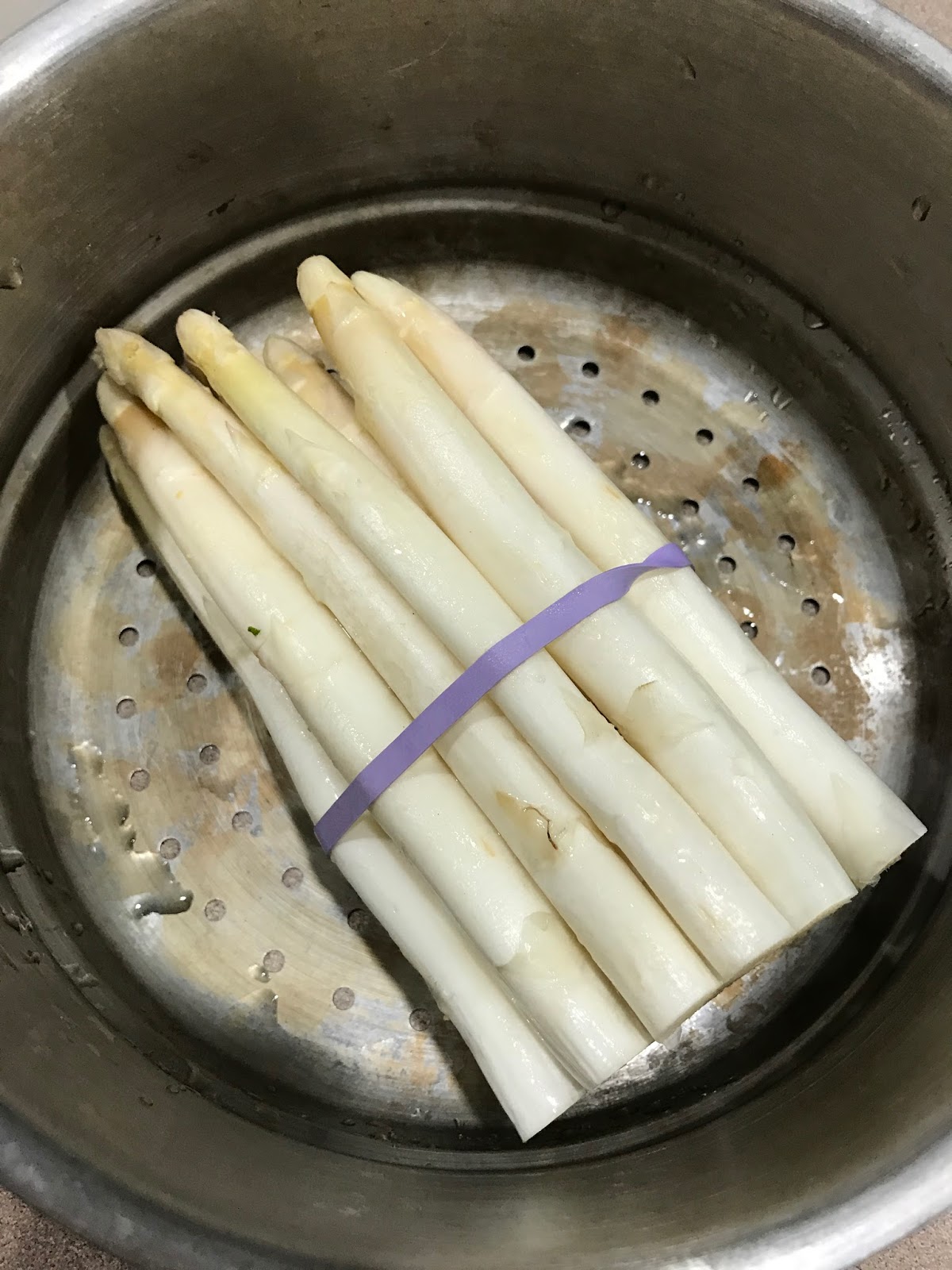
The white asparagus currently available in U.S. food markets comes from Peru. You might notice that the spears are a bit shorter and stouter than green asparagus. 


Some people like to peel the white spears before cooking. You can probably guess which prep method Michel prefers. 


He recently bought one bunch of Peruvian white asparagus at our local supermarket and turned it into two dishes.

As soon as we got home he put the asparagus into a container of water. Why? “It makes them juicy.” 


Later when he was ready to cook, he cut about two inches off the stems and set them aside for making soup.


Michel decided to steam the asparagus for a few minutes. He can’t handle the commonplace boil-the-life-out-of whatever-you-cook method employed in Dutch home kitchens.

Keep an eye on your spears to make sure they are tender enough for your taste. White asparagus is slightly more fibrous than its skinny green relatives and it may need extra time.


Our seasonal white asparagus was topped with a sauce made from shallots, butter, lemon, and juniper berries. 

This is the same sauce Michel made for his version of boorenkoolstamppot. It’s definitely not vegan but it’s worth it once or twice a year. 


Here’s a re-post:

2 shallots, chopped
(coarsely chopped or ground)
1 stick of butter
Juice of one lemon
1 tablespoon dried juniper berries 
Salt and pepper

Melt butter in a small saucepan over low heat. Add shallots, lemon juice, and juniper berries, and a pinch of salt and pepper.


Plate steamed asparagus spears, add sauce, enjoy! 


Saturday, April 15, 2017

Italian Purgatory Beans, Roman Catholic Animals, and Michel's Favorite Dutch Writer


You know you're a hardcore vegetarian when you get excited about discovering a new kind of bean. Michel is very inventive with his vegetarian/vegan cooking but he's always on the lookout for new things to make. Recently we read about an organically grown heirloom bean that comes from the small Italian community of Gradoli,* not far from Rome. 

*Etymology tangent for my fellow word nerds: 
The name Gradoli probably originates from the series of steps (from the Latin gradusone had to climb  to reach the castle built there in the Middle Ages. Long-suffering piano students and teachers will of course make the connection with Debussy's "Dr. Gradus ad Parnassum," his parody of Carl Czerny's piano exercises. 


Gradoli, Italy

On every Ash Wednesday since the year 1600 the town has organized a community lunch, Pranzo del Purgatorio, to mark the end of carnival season and the beginning of Lent. The featured dish: Fagioli del Purgatorio. It's easy enough to understand the rationale for cleansing and purification after a big celebration but my non-Catholic brain has always wondered if purgatory isn't just another unnecessary guilt trip invented by religious leaders centuries ago to make sure their illiterate flocks didn't get out of line. I'm guessing that images like this Fra Angelico painting of The Last Judgment would have been enough to (literally) scare the hell out of wayward parishioners. 


Despite the name, purgatory beans are a totally guilt-free alternative to their less dainty Italian relatives, cannellini and borlotti beans. After checking local stores to no avail, Michel found an importer of Italian food products online and ordered three packages of fagioli del purgatorio right away. The Gustiamo website (← linked here) offers a variety of items and the company ships from its offices in The Bronx. Easy.


Although he doesn't consider himself to be a religious person, Michel has an unexpected soft spot for the Roman Catholic Church. He moved from Amsterdam to Rome as a young man to study the violin with Alberto Lysy. While in Rome, Michel lived in a building owned by the Dutch Roman Catholic Church. His neighbor across the hall was Ben Hemelszoet (whose surname aptly means "heaven sweet"), a Professor in Exegesis at the Catholic University in Amsterdam. Ben and Michel had extensive and ongoing discussions about all things Catholic, in particular the Second Ecumenical Council taking place at The Vatican during the time both of them were living there. 


Visiting the Cathedral in Como, Italy, July 2016

Michel's unlikely attitude toward the Roman Catholic Church is underscored by his favorite Dutch writer, Gerard Reve, who became a Catholic in 1966 and at the same time made it known that he was gay. His irreverent humor and writing style made him a larger-than-life figure in Dutch culture and generated controversy even in the relatively liberal Netherlands. 

Gerard Reve

As a Mariologist, Reve had an obvious reverence for the figure of Mary. From this liturgical point of view, he interpreted the church doctrines to include all sentient beings. Reve considered birds--especially songbirds--and most notably the innocent lamb to be of the highest order, hence his claim that animals must also be Catholic because of their utter innocence and absolute devotion. In a more humorous vein, Reve also wrote that, upon their arrival in Heaven, well-behaved animals would be given nicely fitted clothing. 

Michel has determined that our four Cavalier King Charles Spaniels are Catholic because of their loving, devoted nature and the fact that they come from Irish stock. I can think with that. Reve's works are largely unknown in the U.S. but one of his most famous novels, "The Evenings," was translated into English just last year, seven decades after its 1947 publication. 


Now you know the back story and it's time to get back to the business of purgatory beans. 

This dish takes four cooking implements and about 90 minutes for prep/cook time. You will need one stock pot for cooking the beans, a large skillet for preparing the vegetables, a device for steaming, and your favorite pot for boiling eggs. 

Ingredients:

2 cups of purgatory beans, soaked overnight
1 fennel bulb, chopped
1 bunch of parsley, chopped
5-6 stems of fresh kale, leaves removed and chopped
1 whole onion, peeled
½ an onion, chopped
2 large carrots, chopped
1½ cups of fresh peas (frozen peas will do)
1 lemon for grating zest
5-6 garlic cloves, chopped
6 cloves
2-3 tablespoons of olive oil
1 teaspoon red pepper flakes
2 bay leaves
1 teaspoon dried rosemary 
(or a stem of fresh rosemary if you have it)
1 teaspoon of fennel seed ground into powder

photo: fitbottomedeats.com

To garnish:
4 eggs, boiled
6-8 small heirloom “rainbow” carrots 


Part One: The Beans

Place soaked beans in a large stock pot. Cover with water.

Cut onion in half and stick three cloves into each half.

Add onion halves, bay leaves and rosemary to the pot.


Bring to a boil, reduce heat and cook for about an hour 
(two hours if beans are not pre-soaked). 


Meanwhile, steam the peas and heirloom carrots. 
Set aside.


When the beans are done, add 2 teaspoons of salt and some red pepper if you like.

Add the steamed peas to the pot. Stir gently to mix.


Part Two: Prepare the veggies while the beans are cooking.


In a 3-quart skillet:

Heat 2-3 tablespoons of olive oil.
Add chopped onion, garlic, fennel, and carrots.

“Sweat” the vegetables in olive oil.

When they are done, add chopped parsley, fennel seed powder, red pepper flakes, salt and pepper to taste.


Add chopped kale and let it cook down.


Also add a bit more salt if needed.


Putting it all together:

Pour off excess liquid from beans, saving 
some liquid in a container.

Add cooked vegetables to beans and peas.
Mix gently with a wooden spoon.

Add some bean liquid to make it “sort of soupy.”

Top with grated lemon zest.


Garnish with boiled eggs (halved) 
and heirloom carrots. Serve.

Enjoy all the purgatory bean goodness without the perils of actual purgatory. 


Friday, March 31, 2017

Boerenkoolstamppot: Variations on an Old Dutch (Potato) Theme


Michel seldom makes any kind of potato dish. Their high starch content and potential effects on blood sugar levels are reason enough to use other ingredients. Mind you, he likes potatoes. In fact, one of Michel's favorite American potato incarnations is McDonald's hash browns. Are you surprised? He claims they are the closest thing to the "rosti" he loved to eat in Holland. The resemblance is clear. Rösti has its origins in Switzerland and is traditionally prepared in a skillet like a fritter. Its worldwide popularity is easily understandable. The next time you're in an airport food court you might just see Michel waiting in line for his McDonald's order. 


When his favorite hash browns are not available, French fries will do--McDonald's or otherwise. This substitution is also understandable because of the popularity of Vlaamse Frieten or "Friet & Mayo," readily available throughout Amsterdam and Northern Europe, although the names will vary. Yes, street fries with mayo are messy. They are also mandatory, as the perpetually long lines of customers will attest. 


In the U.S. where sugary ketchup is the usual accompaniment, some restaurant servers have a hard time understanding Michel's request for mayonnaise with his fries. This is partly because they are puzzled as to why anyone would want something other than ketchup but also because they don't understand Michel's (accurate) pronunciation of "mah-yuh-nez-eh" when they're used to hearing "may-naze." Sometimes we just ask for aioli and sidestep the issue.  


Stamppot is quintessential Dutch fare, dating from the 1600s according to some accounts; the English translation “mash pot” lets the reader know that the basic element of this dish is mashed potatoes. Not to worry, because there is no actual stamping of feet involved in the preparation of stamppot. A fork or a potato masher will do just fine.


As best I can tell from the stories Michel has related about Dutch food traditions, there seems to be a lot of boiling (i.e., overcooking) of vegetables and very little concern for fancy ingredients. Nothing wrong with that but I’ve never heard or read any reviews about “that great new Dutch restaurant” not to be missed.


Michel’s new recipe is a much lighter and more interesting vegetarian take on boerenkoolstamppot, a kale and potato mash commonly served with rookworst (smoked pork sausage) draped over the top. The Dutch usually prepare stamppotten (pl.) in the fall when the cool weather makes this comfort food even more appealing. Traditional versions include zuurkoolstamppot (sauerkraut mashed with potatoes), andijviestamppot (endive mashed with potatoes), and the aforementioned boerenkoolstamppot (kale mashed with potatoes).

Traditional Boerenkoolstamppot with Rookworst
Photo: www.la-casserole.nl

A quick note about bothering you with all those very long Dutch terms:
Yes, I am an obsessive word nerd and I am acutely aware that you, patient and potentially hungry reader, may not share my fascination with the visual aspect of Dutch words. Many years ago I told Michel that all those doubled letters—especially vowels—make some words look to my eyes like an unwieldy hand of playing cards. Now he just responds with a patient smile when I pose my usual question about a new Dutch term: “How does that spell itself?”


Michel’s version of stamppot includes the kale and potatoes, of course, but he incorporates mushrooms to provide a meaty texture as well as a delicious sauce made with butter, shallots, lemon, and juniper berries. This recipe will work with fingerling potatoes, new potatoes, or pretty much any kind of potato. Michel used a package of “gem potatoes” from the supermarket this time around—a mix of red, yellow, and purple.


For the sauce you will need:

2 shallots, chopped
1 stick of butter
Juice of one lemon
1 tablespoon dried juniper berries (coarsely chopped or ground)
Salt and pepper

juniper berries
photo: www.naturallivingideas.com

Melt butter in a small saucepan over low heat.
Add shallots, lemon juice, and juniper berries, and a pinch of salt and pepper.
Set aside while you tend to the stamppot prep.
 
Sauce with shallots, lemon juice, juniper berries, butter


To make Michel's vegetarian stamppot you will need:

6-8 stems of fresh kale, leaves removed, rinsed, and cut into small pieces

2 cups of Crimini mushrooms, sliced (any kind of mushrooms will work, combination is best)


24 oz. of gemstone, fingerling, or new potatoes


Olive oil
Salt and pepper
(add some garlic if you like)


Boil potatoes with a teaspoon of salt.


While potatoes are cooking, heat olive oil in a large skillet and add sliced mushrooms.

(Mushrooms should cook with “quite a bit” of olive oil, salt, and pepper.)


When mushrooms begin to caramelize, add chopped kale.


Allow the kale to “cook down a bit” then add boiled potatoes.
Mix gently to keep potatoes whole. (There’s an important reason for having whole potatoes on your plate.)

Spoon kale-potato-mushroom mixture onto plates.


Once on the plate, mash the potatoes with a fork to open them. 
(That’s the fun stamppot part.)

Drizzle shallot butter sauce over mashed potatoes.
Eat. Repeat. Because you will want a second helping.